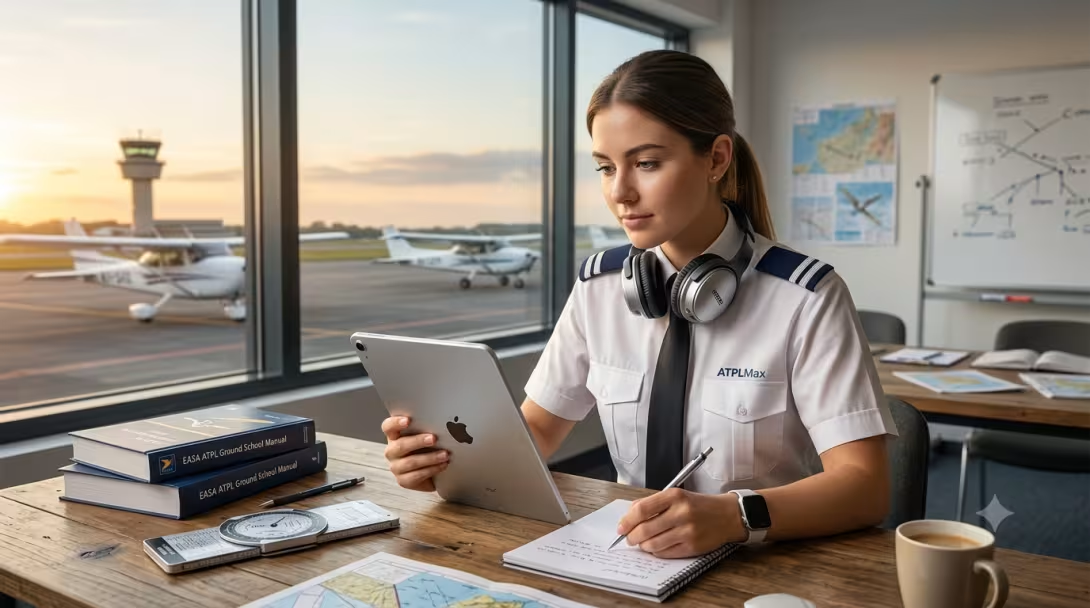
Tackling the 13 theoretical knowledge subjects for an EASA Airline Transport Pilot License (ATPL) is one of the most demanding phases of flight training. While EASA regulations require student pilots to enroll with an Approved Training Organisation (ATO) for mandatory ground school distance learning hours, the vast majority of your actual learning takes place alone at your desk.
With hundreds of hours of independent study ahead, choosing the right revision tools can mean the difference between passing on your first attempt and burning out. That leaves many student pilots asking: Is ATPLMax suitable for self-study, or do you need a different setup to clear your European Central Question Bank (ECQB) exams?
Below is a practical breakdown of how ATPL self-study works, where ATPLMax fits into an effective study routine, and how to structure your revision for maximum retention.
The Reality of EASA ATPL Self-Study
Self-studying for EASA ATPL exams isn't about skipping structured training—it is about taking control of your learning pace. Under EASA rules, you cannot simply sign up for official exams independently; an ATO must sign you off after you complete their distance learning modules or classroom hours.
However, "distance learning" in practice usually means reading digital textbooks independently and testing yourself against exam-style questions. The primary challenges pilots face during ATPL self-study include:
- Massive Information Volume: Retaining concepts across complex subjects like 021 Airframe & Systems, 033 Flight Planning, and 061 General Navigation.
- Understanding vs. Rote Learning: Memorizing answers might yield short-term quiz passes, but EASA's updated ECQB syllabus increasingly tests underlying principles and real-world application.
- Tracking Weaknesses: Identifying missing knowledge before stepping into the exam room to avoid costly retakes.
What Makes a Platform Good for Independent Study?
To study effectively without a teacher sitting next to you every day, your digital study environment needs specific capabilities:
- Clear, Contextual Explanations: A raw question bank that only tells you whether an answer is right or wrong is insufficient. Self-studying requires step-by-step solutions, formulas, and visual diagrams.
- Current ECQB Alignment: Questions must reflect the current EASA syllabus and exam formatting to prevent unexpected surprises on test day.
- Targeted Practice Modes: The ability to filter by subject, subtopic, or previously incorrect answers so you don't waste time re-testing concepts you have already mastered.
- Actionable Analytics: Insights into your average score, subject breakdown, and progress over time to show exactly when you are ready for a mock exam.
Where ATPLMax Fits Into Your Prep Strategy
So, is ATPLMax suitable for self-study? Yes, particularly as a core revision and question bank platform.
ATPLMax is designed specifically around modern pilot learning needs, providing a clean interface that allows self-directed students to move seamlessly between topic practice, detailed explanations, and full mock exam simulations.
Here is how ATPLMax supports independent study alongside traditional study materials:
1. In-Depth Explanations for Complex Questions
Self-study stalls when you get stuck on a tricky calculation—such as point of equal time (PET) or density altitude—and have no one to ask. ATPLMax focuses heavily on detailed explanations, breaking down complex mathematical steps and regulatory nuances into clear logic.
2. Fair Comparison with Legacy Resources
For years, EASA students relied primarily on legacy platforms like AviationExam or Bristol Groundschool (BGS Online). While those platforms remain established, ATPLMax provides a streamlined user experience with modern analytics, intuitive mobile compatibility, and clear explanations that reduce the cognitive fatigue of long study sessions.
3. Smart Filtering & Exam Simulation
During initial reading phases, ATPLMax allows you to isolate specific subtopics to test comprehension immediately after reading a textbook chapter. Once you near exam readiness, you can transition into timed, full-length mock exams that mirror official testing conditions.
How to Build an Effective ATPL Self-Study Routine
Even the best software won't pass exams for you. To make ATPLMax work effectively during self-study, follow this proven three-step approach:
- Learn the Theory First: Never start a subject by blindly grinding questions. Read your ATO's study manuals (such as Padpilot or BGS textbooks) to build foundational understanding.
- Reinforce with Topic Drills: After completing a chapter, use ATPLMax to run custom quizzes on that specific topic. Read the explanations for every question you flag or get wrong.
- Consolidate with Mock Exams: In the final 2–3 weeks before your exam sitting, move from single-topic quizzes to mixed mock exams. Aim for consistent scores above 85–90% before booking your official test.