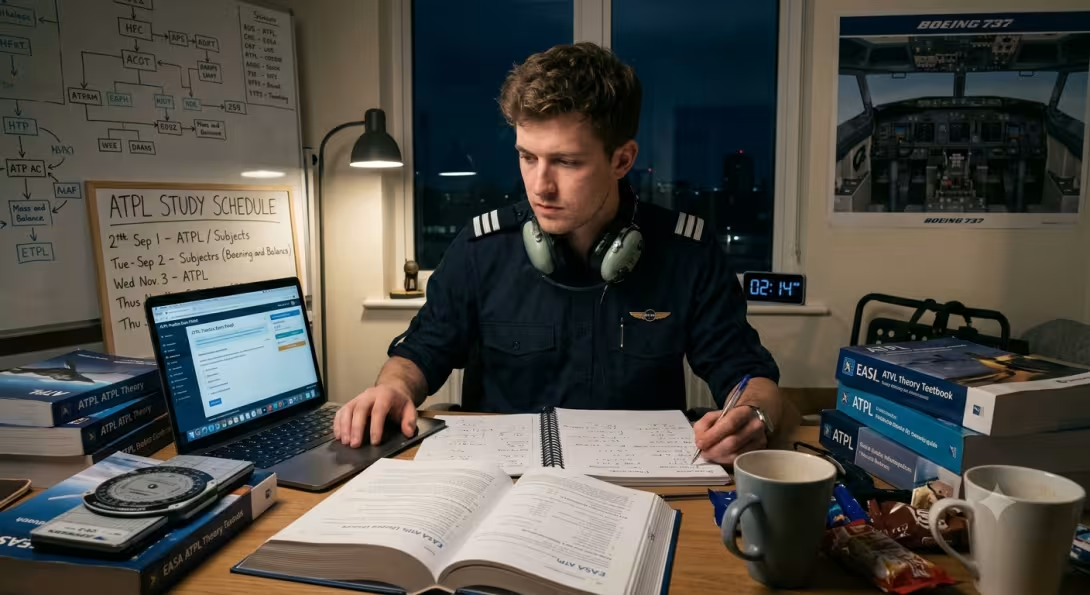
Preparing for the EASA ATPL theory exams can quickly turn into a question of numbers: How many ATPL questions should I practice before the exam? Is 1,000 enough? Should you complete 5,000? Or do you need to work through every question in your question bank?
The answer depends on how you use the questions. For EASA ATPL students, quality of practice matters more than simply chasing a huge number of questions.
How many ATPL questions should you practice?
There is no single number that guarantees exam readiness. A better target is to complete enough questions to understand the syllabus, identify weak areas, and consistently achieve strong results without relying on memorisation alone.
For many students, working through several thousand questions across the ATPL subjects is a reasonable part of exam preparation. However, the total number is less important than your coverage and performance.
For example, answering 5,000 questions while repeatedly guessing through difficult topics is less useful than completing 2,000–3,000 questions while carefully reviewing mistakes and revisiting weak subjects.
Your goal should be to reach a point where you can:
- Recognise the important concepts behind the questions
- Explain why an answer is correct
- Identify common distractors
- Perform calculations confidently
- Revisit questions you previously answered incorrectly
- Maintain consistent results across your subjects
Should you complete the entire ATPL question bank?
Not necessarily.
Large EASA ATPL question banks can contain thousands of questions across subjects such as Air Law, Meteorology, Navigation, Flight Planning, Performance and Aircraft General Knowledge.
Completing every question once can be useful, but repetition with purpose is usually more valuable than simply finishing a question bank.
A better approach is to divide your preparation into stages.
1. Learn the subject first
Start with your ground school material, textbooks, notes or an ATPL course. Use the question bank to reinforce what you have learned.
2. Practise by subject
Work through questions for one subject at a time. This helps you discover where your understanding is weak.
3. Review incorrect answers
This is one of the most important parts of ATPL question practice. Keep track of questions you get wrong and understand the reason behind each mistake.
4. Take mixed tests
Once you have covered the subjects, start practising under exam-style conditions. Mixed tests can reveal weaknesses that are easy to miss when studying one subject at a time.
What should you look for in an ATPL question bank?
The number of questions is only one factor when choosing an EASA ATPL question bank.
Look for a resource that makes it easy to study efficiently.
Good explanations
A question bank should help you understand the answer rather than simply show you which option is correct.
Weak-topic tracking
Your preparation becomes much more efficient when you can identify subjects, topics or learning objectives where your performance is consistently low.
Flexible practice modes
Being able to practise by subject, topic, incorrect answers or custom tests makes a question bank much more useful than a simple list of questions.
Progress tracking
Useful statistics can show whether your performance is actually improving over time.
Mobile and desktop access
ATPL preparation often happens in short sessions between flights, work or other commitments. A responsive web app or mobile-friendly platform can make it easier to maintain regular practice.
Popular ATPL preparation approaches
Students use different combinations of resources depending on their learning style.
Some rely mainly on ground school courses and textbooks, using a question bank for revision. Others use a dedicated ATPL question bank as their primary practice tool.
Platforms such as ATPLQ, AviationExam and other EASA ATPL preparation resources offer large question databases and different study features. The right choice depends on factors such as explanations, topic coverage, testing modes, progress tracking and how closely the platform fits your study routine.
The important point is not simply choosing the question bank with the biggest number displayed on the homepage. A smaller, well-structured resource can be more effective if it helps you identify and fix your weaknesses.
Why ATPLMAX?
ATPLMAX is designed around the practical problem of knowing what to practise next.
Instead of only counting completed questions, ATPLMAX helps students practise across the EASA ATPL subjects, track performance and focus on questions that need more attention.
You can practise individual subjects, build tests and use performance information to make your study sessions more targeted.
That matters because ATPL preparation is not really about answering the maximum possible number of questions. It is about turning practice questions into reliable exam knowledge.
Final verdict
So, how many ATPL questions should you practice?
There is no magic number. Aim to cover your subjects thoroughly, practise consistently, review your mistakes and continue testing yourself until your results are stable.
A strong ATPL question bank should help you understand what you know, what you don't know, and what you should practise next.
Whether you use ATPLMAX, another question bank, a ground school course, textbooks or a combination of resources, the most effective strategy is the same: practise with a purpose, learn from your mistakes and focus on your weak areas.